SENSITU - Application-oriented Sensor Data Fusion for In-Situ Rotor Blade Structural Monitoring

The SENSITU project aims to detect and identify damage or structural changes to rotor blades using sensor nodes within a rotor blade. The sensors include temperature, vibration, and 60 GHz radar sensor technology. This will be tested in a field study on a real rotor blade. Prerequisites include an interdisciplinary team to set up the measurement system, a suitable radar system, data evaluation, and functioning external data transmission. Another goal is to design, implement and characterize a reference error in order to evaluate the performance of radar-based Structural Health Monitoring systems. Finally, the data acquired in the project will be used to create AI models that can classify damage.

The project duration is from August 2023 to July 2026.
(A project extension is currently being sought to complete the experimental phase)

Project partners:

Offshore Wind Turbines<br>

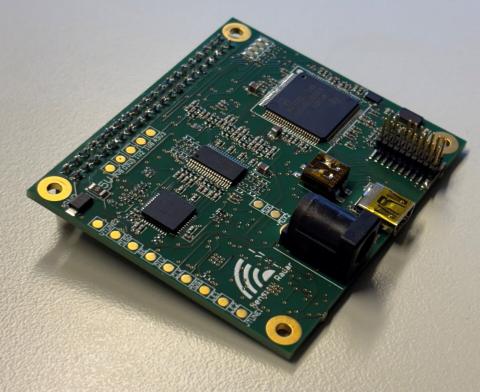
Two different radar devices were set up for the Sensitu project. The first radar with a chip from TI with 3 transitters and 4 receivers provides additional MIMO function for angular resolution and has external antennas (see sR60-3400e). The second version is to be integrated directly into the sensor node and thus becomes an integral part of the planned field study. Both radar variants are frequency-modulated continuous wave (FMCW) radars. In order to cover the selected frequency range from 57 to 64 GHz as effectively as possible, two radar-chips with integrated antennas from different suppliers were built up and compared. This was followed by a detailed examination of both chips with regard to radiation characteristics, SNR (measurement repeatability), and sensitivity. After thorough testing, one of the two radars was selected for further integration into the Sensitu setup (see photos of the 60 GHz radar shield below).

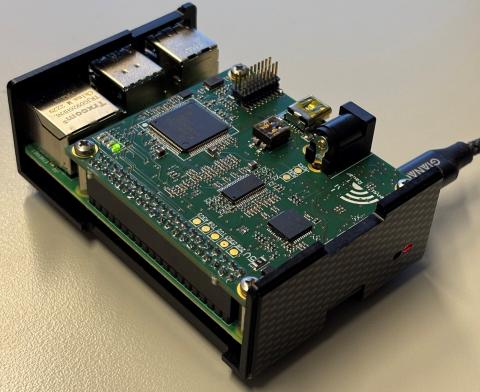
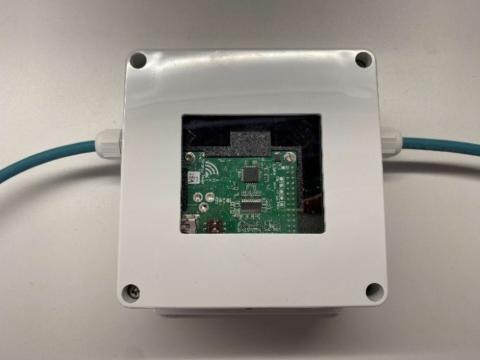
In the next step radar shields were manufactured in sufficient quantities. Cross-platform integration on a Raspberry Pi Model 4 was successful. A suitable housing and radome was constructed after close consultation with partner OVGU. The partners received 14 radars and 14 waterproof housings for further integration.

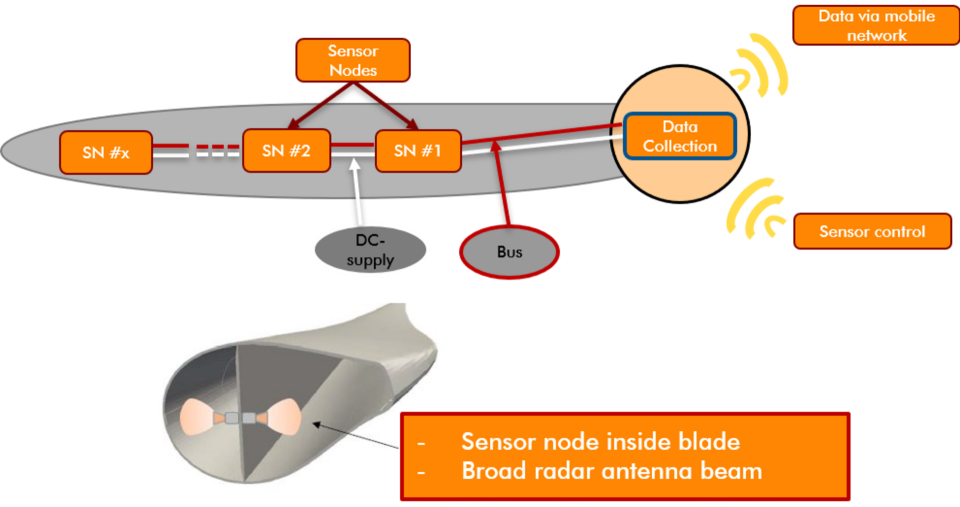
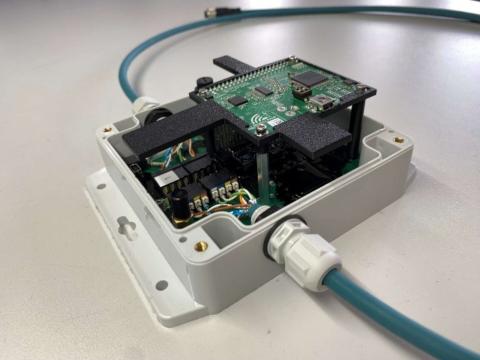
Together with the OVGU carrier board and an acceleration sensor from Wölfel, the radar units were seamlessly integrated into the housings. Individual sensor nodes were successfully subjected to several tests and the entire system was put into operation. Sensor nodes on each wing are controlled by a control cabinet. A radio module in one of the control cabinets enabled access to the recorded data. Finally, the system was installed in a wind turbine near Altertheim.

After the installation of the sensor system, the next steps will be to collect sufficient data for further evaluation.

Illustration of Rotor Blade with Sensor Nodes and Radar Integration

Illustration of Rotor Blade with Sensor Nodes and Radar Integration

Radar Shield with 60 GHz Radar Chip and Antenna-in-Package Technology

Radar Shield with 60 GHz Radar Chip and Antenna-in-Package Technology

Sensor Node with open Lid

Sensor Node with open Lid

Raspberry Pi 4 with 60 GHz Radar Shield

Raspberry Pi 4 with 60 GHz Radar Shield

Sensor Node in Housing

Sensor Node in Housing

Are you interested in our research or looking for a project partner?

Are you interested in our research or looking for a project partner?

Our team is looking forward to working with you!